
Taking Root
a quest for home

“The ache for home lives in all of us. The safe place where we can go as we are and not be questioned.” —Maya Angelou, All God’s Children Need Traveling Shoes
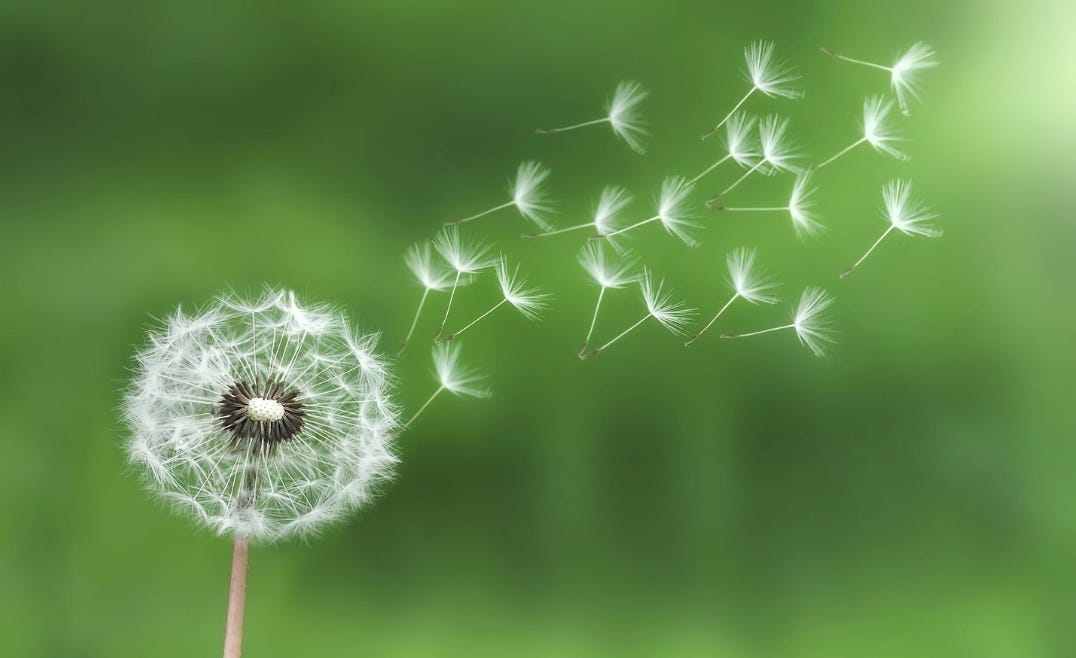
When I’m asked where I grew up, my mind goes blank then scrambles for the correct answer. Is it the suburb of Detroit where I was born and lived until I was five? Is it the rural town in Connecticut where I went through middle school? Or is it Traverse City in northern Michigan where I went to live with my mother just before starting high school? I don’t think of any of these places as my hometown.
My answer would have to be based on a definition of “hometown” and not on any real sense of home or place. But, when I look it up, things aren’t any clearer for me: “the town or city that a person is from, especially the one in which they were born and lived while they were young”.1 Anyway I look at it, there are multiple answers to that question, and no answer.
Most of my life I have felt like a puff of dandelion tossed across the earth. There is no place that I call home, except for the house I currently live in at any given time. When people speak of “going back home” my mind spreads out in multiple arcs, not taking root anywhere, flimsy white filaments skittering in the wind.
*
I was born in Garden City, Michigan, the location of the nearest hospital to Westland, a suburb of Detroit where my family lived. I always loved the sound of being born in a place called Garden City, conjuring up endless swaths of flowers winding between houses and buildings in my mind. It was originally designed after a “garden city” concept that was popular in England in the 19th century.2 The idea was to create house lots large enough for the family to grow their own fruits and vegetables. Most of those lots got chopped down over the years though, some as small as 40 by 135 feet. Now, it’s like any other Detroit suburb.
Our neighborhood in Westland was a grid of small, closely spaced ranch homes, filled with young families and the elderly. Most of the houses were brick, with short cement driveways and chain link fences delineating the small backyards. In the summer at night, the kids ran wild and unsupervised through the quiet streets, playing “kick the can”, and pool hopping from one backyard pool to the next. The community-wide signal to go home was the flickering on of the street lights.
Our neighborhood felt unfamiliar and exciting, like something magical could happen at any moment.
I, however, was too young to participate in the sprawling nighttime games and shenanigans. My view was cropped down to our front stoop and the small stretch of street right in front of our house. My best friend, Cherylynn, lived across the street, and her older sister was friends with my middle sister. Sometimes, thrillingly, the four of us were allowed to gather on one of our stoops in our pajamas and have a snack before going to bed.
The night would be shading the sky darker and darker as we watched the street lights pop on. There was a quiet strangeness outside at night, a quiet that was tangible even under the whoops and yells of the big kids, my oldest sister included, heading home. Our neighborhood felt unfamiliar and exciting, like something magical could happen at any moment.
*
When I was five my Dad was transferred from his job at the Uniroyal plant in Detroit, to Connecticut. We went from a small ranch house in a lower middle class suburb to a large white colonial in the rolling green hills of northwestern Connecticut. We lived on a steep hill, deep woods behind us, open fields across the street and to one side, and a string of widely spaced homes stretching down the road to the other.
The hanging flaps of branches and leaves felt like a protective canopy everywhere I went, towering above me. In the summer, everything was saturated in shades of green, from the dark shadowy moss and emerald greens throughout the forest behind our house, to the sunlit chartreuse of the topmost leaves of the big tree in our front yard, to the expanse of field grass across the street as far as you could see.
At the top of the hill, not visible from our house, but within walking distance, sat a colonial home much larger than ours, with a pool. Instead of the traditional New England white, this house was painted yellow, and in it lived four kids my age and younger who became my playmates the way kids become friends based more on proximity than anything else.
Their house had enough bedrooms that each kid had their own room, plus a few extra. Periodically one of them would decide to switch to one of the vacant rooms, and we would all help haul their mattress, push dressers, pile clothes and toys, across or down the hardwood floor of the hall into the new room.
Most of our time, though, was spent outdoors. One of our favorite games was foursquare which we would play in the street in front of my house. We used chalk to draw the numbered grid, and would take turns being the lookout for cars while the rest of us played.
Down the hill we had a long view and could see the cars coming with plenty of time to move to the sides of the road. But, the top of the hill was much closer, cars suddenly appearing at the crest, the lookout yelling “CAR!” as we all scrambled to the sides of the road, adrenaline lighting up the cells in legs and arms.
No adults were supervising us, and it felt like we were our own unit, a team each with a job, looking out for each other. The road stretched long below us, but our world was bordered invisibly the width of our yard, a sphere like the iridescent bubbles blown through ridged plastic circles dipped in small plastic containers of liquid soap. It existed within the world of adults, but a bit separate, a world of our own creation.
I also spent a lot of time outside alone. Eventually, tensions rose inside our house as my parents moved down the road toward divorce. It was unsettling and frightening. Outside I felt like I was in my own protected world, the feel of grass on my bare feet, making soup out of twigs and leaves, dandelions and grass, stirring it in a big pot with a wooden spoon.
Often I would bring out two blankets and a book, laying out one blanket on the ground in the little alcove of trees between my house and the neighbors. The other I would drape over branches creating a soft door. I would lay on my stomach in the glowing light within my little cave and read, the sounds of birds and an occasional ant walking across my arm keeping me company.
The heat of the summer day would fill with cool pockets as the sun went down. Even though underdressed, getting chilly and hungry, I was reluctant to go inside and leave the world of my own making, the world where I felt like I was home, like I truly belonged.
*
When I was nine my parents did get divorced and my mother moved to Traverse City in northern Michigan to live with her mother. Three years later, my mother now living with the man that would become my stepfather, I moved to Michigan to live with them. We lived in a split level surrounded by a large yard, with woods surrounding that. Our house sat at the end of a dirt road and our nearest neighbor was a quarter mile away.
Even though I was entering my teenage years and was inevitably playing less, I still spent a lot of time outside, mostly by myself. I would go for walks down our dirt road, or through a trail in the woods. In the winter I tried my hand at cross country skiing, unsteady and hesitant, sliding up and down the small rises and falls on our property. I felt a kinship somehow with the stark branches of trees against the whitish gray winter sky. Alone but not lonely.
For my sixteenth birthday my mother gave me a camera, a Pentax K1000. I bought a camera bag with money earned from my waitress job at a mall sandwich shop filled with grungy kids and harried parents. The bag was mustard colored with black zippers and lots of compartments which, in addition to the camera itself, I filled with lens cleaning solution and soft gray lens clothes, filters, and the instruction booklet for my new camera.
The camera had a wide black nylon strap with PENTAX printed along it. I would walk slowly around our property with my camera hanging around my neck by the strap, looking at my surroundings with an imaginary rectangle frame superimposed over my vision, looking for the right shot. My eye would zoom in, then pan out, examine shapes, patterns and shades, the colors flipped monochromatic in my mind, to match the black and white film.
The world narrowed down to frame -sized and also bloomed outward in detail and vibrancy. I was an observer, but also intrinsically linked to the world around me: The “Old House” across the driveway, not liveable but used for storage, a tire swing hanging on frayed rope from the tree next to it. The old boards faded and warped, emitting a nostalgic cloud of mothers in aprons baking bread. The patterns of leaves and branches in unmetered crisscross against the sky. Zoomed in flowers showing the streak and lines of petals and stems and leaves.
With my camera in my hand, the outdoor world felt even more enclosed in a familiar, protective embrace, a shimmering bubble.
When I was 18 I moved out on my own when my mother announced that she and my stepfather had bought a hunting camp in Canada. Technically I probably could have gone with them but it wasn’t offered. Besides, they were moving to Ontario, north of Michigan to the middle of the “bush” where the temperatures could get to 60 below.
Instead, I moved back to Connecticut. The man who is now my husband was then my long distance high school sweetheart. I called him and he said, “I’ll come get you.” and he did, just a few days later.
We broke up soon after though we remained friends. Five years later, I moved again, this time to Colorado. Then Arizona, Colorado, Florida, Colorado for the third time, and now Connecticut again.
I think that the pattern of leaving was set into my bones as a child. There was a 6-9 year rhythm of moving on that I couldn’t seem to help obey. I have lived in many houses, close to thirty, in many different towns in several different states. Some places I’ve gone back to over and over, like I was waiting for something to stick, for my roots to finally sink in far enough to not get blown and pulled out by the wind.
It’s like the dandelion puff that was our family was blown apart and scattered, the delicate filaments too weak to hold us together. Everyone took root somewhere but me.
Even though I have moved around by far the most out of anyone in my family, most of my life we have all been separated from each other, strewn across the land. It’s like the dandelion puff that was our family was blown apart and scattered, the delicate filaments too weak to hold us together. Everyone took root somewhere but me.
This is my third time living here in the extravagant greenness of northwest Connecticut. Before this last move, leaving had been easy. I rolled across the land to a new place, light and full of hope, even if not always happy nor without struggles. But this move was the resolution to three tortuous years of court battles with my daughter’s father, trying to create enough distance for her to be out of range of his addictions, violence and manipulation. This move felt like I dragged a boulder across the country attached by chains to my back.
Now, I live in a large three story house with my husband, and our three kids. Our house is surrounded by woods and I can just see the nearest neighbor’s house through the trees. My husband runs his construction business out of the large two story, two bay garage attached to the kitchen. Sometimes there are workers and machinery moving all over the property. Sometimes they all leave for a job site, leaving just the sounds of the birds and the periodic swoosh of traffic down the road at the end of our long driveway
I still spend a lot of time outside alone but with my dogs. I sit in the lawn chair I pulled out from under the deck once the snow had all melted and the ground dried out enough to hold the chair legs steady. I wear a straw hat and my prescription sunglasses, bring my phone, my kindle and my new pair of binoculars, a Mother’s Day gift from my stepson.
Sometimes I take off my sunglasses and hold the binoculars up to get a closer look at the tree swallows with their startling blue wings—my favorites. Or I watch the neighborly robins hopping through the grass looking for lunch among the green blades.
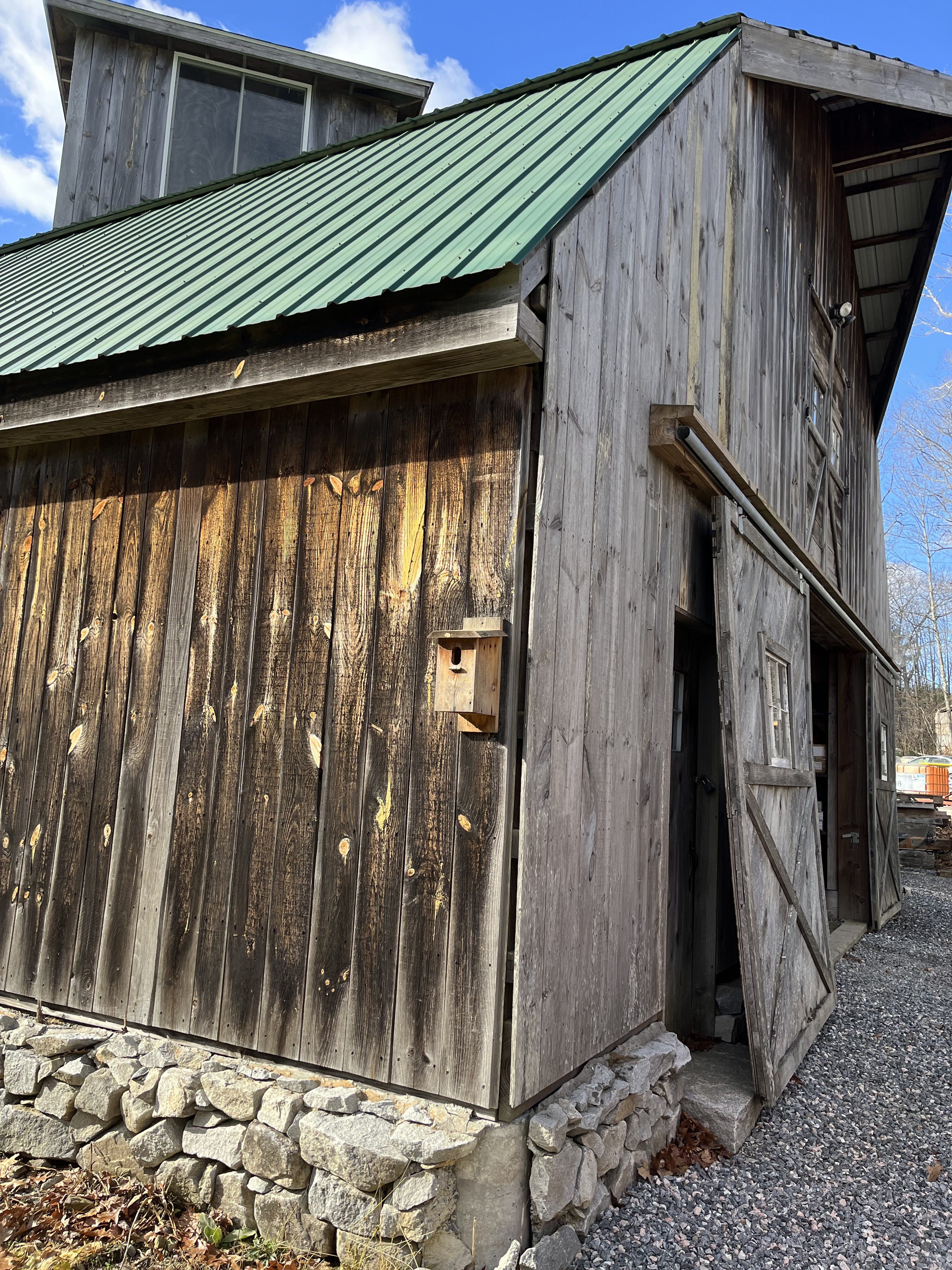
Usually though I just sit. I slip off my magenta Crocs, a gift from my stepdaughter, and sit with my bare feet against the grass, the hopeful yellow faces of the dandelions nestled among the blades. I feel an easy companionship with the trees and the birds and the wind. I watch the birds swoop from the trees to the wooden bird house a friend made for us attached to the gray barn with a green metal roof my husband stores equipment in.
I feel that sense of a soft protective sphere enclosing me, but now it is larger and contains our whole house, my whole new family. When one of our kids comes home, they walk across the yard to see me, the dogs bounding to greet them. As my husband comes and goes from the job site, or Lowe’s or the part’s store, he rounds the corner from the garage doors to come visit me, smiling, gives me a kiss, tells me where he is heading next.
As I watch him walk away, knowing he will be back soon, I press my feet into the ground and imagine my roots growing down into the soil, just another tree living in its place.
✨✨✨
What does home mean to you? Have you lived in the same place your whole life or moved around? Do you have a place that you call home? I’d love to hear your thoughts in the comments❤️
I’m so happy you’re here! If you enjoyed this essay, please click the heart to help other people find my writing. And, of course, if you haven’t already, I invite you to subscribe to receive weekly poems and essays, where I mine every corner for truth, meaning and beauty.
https://dictionary.cambridge.org/us/dictionary/english/hometown
https://en.wikipedia.org/wiki/Garden_City,_Michigan
Beautifully written!
Kristi, that was just beautiful! Thank you so much for sharing. Your story carries such tenderness, and I hear the ache in not having a single place that feels like 'home'. However, what you’ve shared shows how deeply you’ve lived in each landscape, finding pockets of belonging in woods, stoops and camera frames even as family life shifted.
It’s clear that home for you has been less about geography and more about those moments of healing, safety, creativity and connection you carved out for yourself. That resilience, turning each place into a bubble of protection or a lens of beauty ... is profoundly moving, and it speaks to the strength of someone who has learned to carry home within.
To me, I sense that 'home' is somewhere I feel seen and safe enough to let my roots stretch, even if they’ve had to move many times too. Substack, has become a home of sorts for me. I've written about it in my latest post. As always, my dear friend, there's so many synchronicities between us. 🐦🙏💖